“Way, Truth and Life: Jesus in a Pluralistic world”
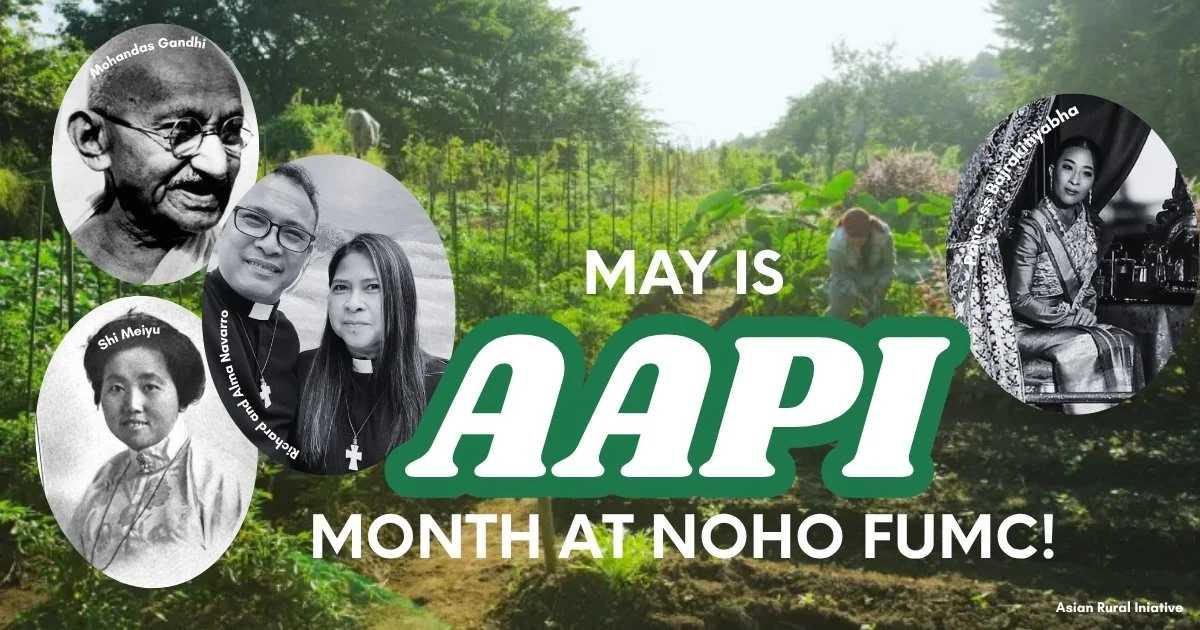
Good morning and thank you for being with us as we begin our celebration of Asian American / Native Hawaiian / Pacific Islander Heritage Month. I hope you will join us after worship to experience the glory of Indian food and the opportunity to learn more about education in rural India. For those who are new to our community, (along with being the pastor of this fine church) I am the founder of a non-profit organization called Friends of Padhar Schools and we raise funds to support scholarships for girls and young women, programs to bring technology into village schools, support for teacher’s salaries and essential equipment and materials for 2 schools in the state of Maharashtra.
John Wesley, the founder of Methodism, emphasized, in establishing this new movement, one of the characteristics of our new church was that we “think and let think.” That love, acceptance and respect - UNITY - was more important than uniformity. But it can be difficult - to love one another through all our differences, and when it comes to differences in faith traditions, we human beings have a hard time accepting and respecting one another. How do we interact with people who believe differently than we do, especially in their opinions about God?
Our scripture text today from the gospel of John contains many of the most recognizable and beloved texts, including the one on which we focused for the memorial of Roger Eshleman: “In my Father’s house there are many rooms….” And it also includes a text that speaks to our need for direction and guidance and reassures us that we are following the right path.
But this text from the gospel of John has also been misused and misinterpreted and has caused harm to so many people, both followers of Christ and others. John 14, verse 6 says ‘Jesus said, “I am the way and the truth and the life. No one comes to the Father except through me.”
So today, we are going to look at this text in two ways today:
First we are going to examine the context of this saying - Why did Jesus say it? What were the circumstances he was speaking about? To whom was it directed or for what reason did Jesus say these words?
Secondly we’ll look at the words themselves and talk about how the translation of ancient texts impacts our understanding of the text. And how easily one simple word can make all the difference in our understanding.
So, let’s do this.
Now, this text in John, chapter 14, comes immediately before the Arrest, Trial, and Crucifixion of Jesus. It happens at the conclusion of the Last Supper Jesus shared with his disciples, after he washes their feet and explains that he will soon be leaving them. These chapters in John (chapters 14-17) are known as the “Farewell Discourse,” a speech Jesus gave to those closest to him as he was preparing for his death. And he begins:
“Do not let your hearts be troubled. You believe in God believe also in me. 2 My Father’s house has many rooms; if that were not so, would I have told you that I am going there to prepare a place for you? 3 And if I go and prepare a place for you, I will come back and take you to be with me that you also may be where I am. 4 You know the way to the place where I am going.”
Author Brian Stoffregen explains, “The command "Don't let your hearts be troubled," is one that not even Jesus fulfilled. The same word is used of Jesus in John 11:33; 12:27; and 13:21. If at times Jesus had a troubled "soul" or "spirit," how would we expect not to have troubled hearts? What troubled Jesus in these three instances was the power of death. [In this command, Jesus tells us that] We, who live on the other side of the resurrection, should not fear the power of death.” (1)
In these words, Jesus is trying to inform the disciples of what will come, comfort them in their confusion and worry and assure them that they would not be left alone. God would send the Holy Spirit to comfort and guide them. But - as you can imagine - the disciples were confused, dismayed and yes, troubled. In verse 5, Thomas said, “Lord, we don’t know where you are going, so how can we know the way?”
6 Jesus answered, “I am the way and the truth and the life.”
Jesus tells Thomas (the disciple who doubts - who needs proof and evidence) “Your evidence is ME: my life, my teachings, my words, my leadership. If you follow me, you will know the Way.”
But because of a definite article used in this text, we read “I am the way…” as “I am the ONLY way…”
"I am the way, the truth, and the life,”
Now, the gospel of John was written in Koine Greek and is dated between 90-100 of the Common Era. Koine Greek was the common, international language of the Mediterranean world, which allowed the gospel to reach a broad audience. In the famous declaration "I am the way, the truth, and the life," the Greek text actually includes the definite article (hē) before all three nouns.
"I am the way, the truth, and the life,”
But both Hebrew and Aramaic do not have definite articles. Therefore, some scholars argue that if Jesus spoke these words in Hebrew (the language of the Temple) or Aramaic (his first language), the absence or presence of this article would drastically shift the meaning from "the only way" to "a way.”(2) Did Jesus speak these words and if so did he say:
"I am way, truth, and life?”
How does removing the definite article change our understanding of the text? Now I will acknowledge that the second part of verse 6, emphasizes the exclusionary aspect of the message. The whole of verse 6 says, “I am way, truth and life. No one comes to the Father except through me.” But we can explain the image as a teaching method - we cannot understand God as a Father-figure, without understanding Jesus as his child. There are other aspects of God and the Father is an important aspect to understand, but it is not the only way in which God works…
Furthermore, if Jesus was trying to teach us who to include and who to exclude, we can look at his LIFE and the example he showed to his followers:
Jesus engaged with the marginalized, outcasts, and tax collectors like Zacchaeus, in Luke 19:2-4.
He conversed with women, like the Samaritan woman at the well in John 4: 4-42, defying cultural barriers.
Jesus touched and healed those who were sick in body and spirit, like the man born blind in John chapter 9 and those who were demon-possessed in Matthew chapter 8.
He welcomed children, day laborers, those who were in the throws of mourning. He used as examples those who were from different cultures and different faith traditions ((Luke 10:25–37, Luke 4:25–27).
Surely, if Jesus meant for us to regard others with judgement, hatred and rejection, his command to love our neighbors, and even our enemies, would have mentioned those we could reject?!?
SO, how does this text speak to our current context? How does it speak to religious pluralism, living among people of different faith traditions, different beliefs and values.
Mohandas Gandhi was born October 2, 1869 and died January 30, 1948. He was an Indian lawyer, anti-colonial nationalist and political ethicist who employed nonviolent resistance to lead the successful campaign for India's independence from British rule, and to later inspire movements for civil rights and freedom across the world. The honorific Mahātmā (Sanskrit: "great-souled", "venerable"), first applied to him in 1914 in South Africa, is now used throughout the world. (3)
Though a deeply devout Hindu, Gandhi's basic approach to all religions was 'sarvadharma samabhav' [SAVRA - DHARMA SAMA-BAV] or equal respect for all religions. For him all religions had equal status and were different paths to the same goal of achieving union with the Divine. His religion was that "which transcends Hinduism, which changes one's very nature, binds one … to the truth within and ever purifies. It is the permanent element in human nature which leaves the soul restless until it has found itself, known its maker and appreciated the true correspondence between the maker and itself.” He affirmed "For me different religions are beautiful flowers from the same garden or branches of the same majestic tree." (4)
One of the values I hold dear as a United Methodist is our understanding that not everyone will agree with us. We “think as let think” as our founder John Wesley assured us. In Wesley’s 1750 sermon titled “A Catholic Spirit” ( catholic meaning universal), he said “Though we cannot think alike, may we not love alike?” Acknowledging that we will all have different opinions, beliefs and values, but that doesn’t mean we can turn our backs, ignore or reject those who believe differently. “Though we cannot think alike, may we not love alike?” Love is always the priority.
And so, my friends, let us love one another, even among our differences. Let us love our neighbors - our Hindu, Jewish, Muslim, Buddhist, Roman Catholic, Evangelical, agnostic, and atheist, etc… neighbors as our great God has loved us. May we continue to live the values of Jesus, now and always, Amen.
Brian Stoffregen, https://www.crossmarks.com/brian/john14x1.htm
“One Missing Word Changes the Entire Gospel,” Data Over Dogma podcast, April 29, 2026
Found on https://en.wikipedia.org/wiki/Mahatma_Gandhi
“Gandhi, Christ and Christianity” by Pascal Alan Nazareth, found on https://www.mkgandhi.org/articles/gandhi_christ.php